
Coloring and the Nervous System: How Small Choices on the Page Begin a New Story
By Jean Dorff, trauma recovery coach and founder of The Empowering Story (TES). Last updated October 9, 2026.
In short: Coloring can support nervous system regulation for some people, some of the time. It offers a bounded, low-stakes activity with built-in choices, and a nervous system that learned through experience often updates through new experience. Coloring does not treat trauma on its own, and its effect depends on the design of the page and on the person holding the pencil.
Picture someone sitting with a coloring page. The lines already exist. She did not have to invent anything from nothing. And yet almost every decision still belongs to her. Where to begin. Which color. How much pressure. Whether to stay inside the lines. Whether to finish at all.
That combination interests me more than the coloring itself. Because the page is doing two things at once. It offers orientation, and it preserves choice.
I have come to believe that this combination describes something much larger than a page and a pencil. It describes what makes an experience usable for a nervous system that has learned to brace.
A Container and a Demand: Why the Design of a Coloring Page Matters
There is a difference between structure that holds you and structure that tests you. From the outside, the two can look identical. The same page, the same pencils, the same quiet room.
A container gives you somewhere to place your attention. It says: you do not have to create everything from nothing. You can enter here, and your choices still matter once you are inside.
A demand takes the same structure and turns it into a task. Now there is a right way to do it. Now the activity that was supposed to bring ease has become one more thing to perform correctly or fail at.
I learned this watching coloring pages fail. If a page is too intricate, too crowded, too perfectionistic, it can recruit exactly what we were hoping to soften: perfectionism, hypervigilance, self-criticism. The design itself carries the message.
"A good container does not tell you what must happen inside it. It makes it possible for something to happen safely enough that you can participate in it."
That sentence took me decades to arrive at. The coloring page was simply where I could finally see it clearly.
The Principle Travels: Dance, Trauma Work, Learning, and Leadership
I spent more than forty years in dance before I ever thought about coloring as anything meaningful. And the same tension lives there.
Give dancers too little structure and they become uncertain. They do not know where to place attention. Give them too much structure and the dancing stops. They start executing. Technique exists to make expression possible, and when technique becomes the point, expression goes quiet.
Trauma work carries the same tension. Without a container, experience can become overwhelming. When the process becomes too prescribed, too interpretive, too goal-driven, the person can lose agency inside the very process that was supposed to help restore it.
Learning seems to work in a similar way. Guidance can reduce uncertainty. But when the learner is rewarded mainly for reproducing the expected answer, the structure can stop supporting learning and start training compliance. Research on autonomy and motivation, including self-determination theory, points in a similar direction. The learner still has to participate for anything to take root, and compliance is a different thing from participation.
Leadership seems to work this way too. Criteria can orient judgment. But when the framework begins deciding in place of the person, structure can cross into compliance. Judgment has not been supported. It has been replaced.
These parallels come from my own observation across very different settings, so I offer them as a lens to test. In each of them, the useful question stays the same. Does this structure give this person enough support to feel held, without creating so much demand that they start to feel trapped?
Why Understanding a Trauma Response Doesn't Calm the Nervous System
Here is where the principle meets the body. Two things can be true at the same time. You can know, cognitively, that you are safe, and your nervous system can still behave as though you are not.
You may have done the work. You understand the trigger. You can name the response while it is happening. And the heart still races. The stomach has already changed. Attention has narrowed.
"Understanding and regulation are not the same process."
Much of what we call a trauma response can happen quickly and largely outside conscious deliberation. Researchers describe this in different ways, and the science is still developing. One useful way to picture it is that the nervous system keeps evaluating sensory information, bodily signals, memory, and context. It asks, in effect: what does this resemble, and what have I learned to do when something resembles this? By the time conscious thought arrives, the body may already have begun its response.
"The nervous system is not asking for a fact. It is responding to a prediction."
That distinction matters. Telling yourself there is nothing to be afraid of may be factually correct. In my experience, and in the somatic and experiential approaches I draw on, predictions shaped by experience often shift most deeply through new experience. Cognitive approaches help many people too, and in practice the two tend to work together. The body often needs new information as well, and that information can arrive through sensation, movement, rhythm, orientation, relationship, and repeated experiences in which the nervous system encounters something different from what it has learned to expect.
Thinking still has real value. Naming something can create distance. Understanding can restore context. Cognition helps you orient to the response. Changing the response usually asks for something more.
How to Tell Whether Coloring Is Regulating or Activating
This raises an honest question: how do you know when an activity is actually regulating?
Much of what gets sold as nervous system regulation is essentially a performance of calm. I am careful with that, because a person can look peaceful while bracing.
"Regulation is not the same thing as being quiet."
A nervous system can become quieter because it feels safer. It can also become quieter because it has moved into a more shut-down state. Someone can be very still, very compliant, very focused, with no ease anywhere in it. Trauma literature often describes this as a freeze or shutdown response, and polyvagal theory offers one widely used map of it, though that theory is still debated among scientists.
So I watch for flexibility instead of stillness. Can the person pause? Can they change colors? Can they leave something unfinished? Can they make a different choice without distress? Can they notice what they feel without immediately needing to fix it?
When something regulates, there is usually a little more room. Breathing eases. Movements slow without collapsing. A small choice stops feeling loaded. When the activity crosses into activation, the task tightens. More urgency, more correction, more concern about doing it right, more gripping of the pencil.
The honest measure, for me, is this:
"Whether the person has a little more choice after doing it than they had before."
What Coloring Can and Cannot Do for Trauma Recovery
I want to be precise here, because wellness language can make almost anything sound like a treatment.
Coloring cannot resolve trauma by itself. It cannot undo what happened, change the conditions someone is still living in, or replace a relationship in which someone is finally believed and safe. It cannot do the work of therapy or medical care when those are needed. If someone picks up a coloring book believing that doing it correctly will heal them, we have turned another activity into a test.
What it can sometimes do is smaller, and in my view more credible. It can change the conditions of a moment. It can give attention somewhere to go, give the hands something rhythmic and predictable, create small experiences of choice, and interrupt for a while the demand to explain, solve, or perform.
The research is limited, but it is consistent with this modest framing. In a 2005 study published in Art Therapy, Nancy Curry and Tim Kasser found that coloring a mandala or a plaid pattern reduced induced anxiety more than coloring on a blank page. A later replication found mandalas outperformed the other conditions, so the findings on which structure works best are mixed. A 2017 study by Jayde Flett and colleagues in the Creativity Research Journal found that adults who colored daily for one week reported lower anxiety and depressive symptoms, while a control group doing logic puzzles did not. These studies used nonclinical samples and measured short-term effects, so they say little about trauma recovery directly. Read together, they suggest that structured coloring can ease anxiety for some people in the short term, which fits what I observe in practice.
And it will not be regulating for everyone, every time. For one person, coloring creates ease. For another, it triggers perfectionism. Someone else may need to walk, dance, work with clay, or talk. So I would never say this regulates the nervous system. I would say this can create conditions that some nervous systems find regulating. Then you pay attention to what actually happens.
Evidence, Gathered Slowly: How Small Choices Update a Prediction
When you create an activity with boundaries that are clear without being coercive, you are offering the nervous system a different kind of information. There is a page. There are lines. There is a beginning point. You can choose the color, stop, continue, leave a section blank, go outside the lines. Nothing bad happens.
That is small, but I do not think it is trivial. Because the system begins to receive evidence:
"I can act without being punished. I can make a choice without having to get it right. I can engage without being trapped. I can stop without failing."
For someone who has spent years living in anticipation, anticipating danger, judgment, conflict, or rejection, those moments matter. Repeated often enough, in low-stakes conditions, they become the kind of experience a prediction can actually update around.
The pencil was never the point. The page was never the point. The point is that for a few minutes you may be able to experience yourself as someone who can make one small choice, see what happens, and then make another.
"Maybe I do not have to argue with my nervous system. Maybe I can begin giving it different experiences."
Over time, those experiences accumulate into new evidence. That evidence will never promise that nothing difficult will happen. It says something quieter and more durable: I may still feel the activation. But I am not as completely organized by it.
I have more choices now than I had then.
The goal was never a person who looks calmer. The goal is enough room for more choice.
A Few Pages to Try
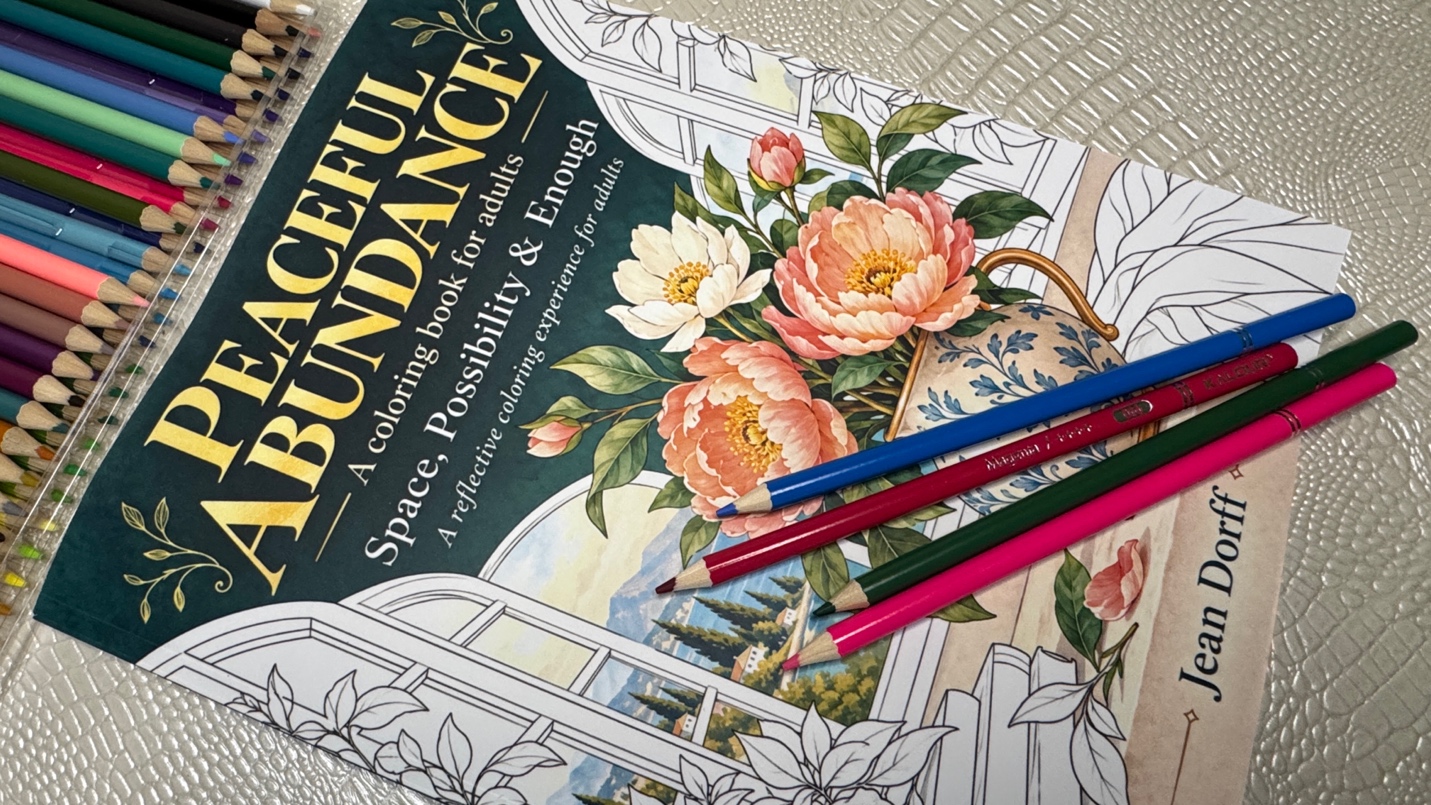
Peaceful Abundance: Volume One grew out of many of the principles explored in this article: clear structure, spacious design, first-person perspective, reflection, and enough freedom to make the page your own.
I created a short sample with three selected coloring spreads so you can experience the approach before deciding whether the full book is for you.
The free sample is here: innerconditionpress.com/free/peaceful-abundance-edition-1
The full book is here: https://www.amazon.com/Peaceful-Abundance-Possibility-Reflective-Experience/dp/B0HLY23KWN
Frequently Asked Questions About Coloring and the Nervous System
Does coloring help regulate the nervous system?
Coloring can create conditions that some nervous systems find regulating. It combines rhythmic hand movement, a clear visual boundary, and small low-stakes choices, which can give an activated system something safer to organize around. The effect varies from person to person, so the honest approach is to try it and notice what actually happens.
Can coloring heal trauma?
Coloring cannot resolve trauma by itself. It cannot undo what happened or replace therapy, medical care, or safe relationships. What it can offer is a few minutes of changed conditions, and from that slightly different state, feeling, noticing, or finding language may become more possible.
Why doesn't understanding my trauma response make it stop?
Understanding and regulation appear to run on different processes. One influential way to describe it is that the nervous system responds to predictions shaped by past experience, and in many people those predictions shift most deeply through new experience. Insight helps you orient to the response, and the body often needs repeated different experiences alongside it to change the response.
What kind of coloring page works best for an activated nervous system?
In my practice, pages with clear, open lines and fewer, larger spaces have tended to work as a container for many people. Very intricate, crowded, or perfection-oriented designs can recruit self-criticism and hypervigilance instead. A design that settles one person can still unsettle another, so the useful test is whether the page gives you enough structure to enter and enough freedom to make it your own.
How can I tell if coloring is helping or making things worse?
Look for flexibility rather than stillness. If you can pause, switch colors, leave a section unfinished, or change your mind without distress, the activity is likely supporting regulation. If you notice gripping, rushing, repeated erasing, or rigid stillness without ease, the activity may have shifted into a demand, and a different activity such as walking or movement may serve you better.