
How Trauma Disrupts the Body’s Love Circuit—and How to Relearn Trust Through Neuroscience and Choice
For survivors of sexual abuse seeking evidence-based methods to rebuild trust, intimacy, and the capacity to love safely again.
Your body remembers what your mind tries to forget. For survivors of sexual abuse, this isn’t poetry. It’s physiology.When someone you trusted used the language of love as a mask for harm, your nervous system learned a tragic equation: love equals threat. Not as a belief you can think your way out of, but as a biological truth written into your amygdala, your breath, your capacity to soften in someone’s presence. The good news? That same nervous system can learn again. Not through willpower or positive thinking, but through something more fundamental: the conscious, repeated choice to love — starting with the choice to trust your own body’s signals again.
I’ve spent years working with trauma survivors through The Empowering Story, combining somatic healing practices with neuroscience research. As a trauma survivor myself and now a trauma-informed narrative coach, I’ve learned this: healing doesn’t happen through willpower alone, but through understanding how your nervous system works — and giving it what it actually needs to feel safe again. In this guide, I’ll walk you through the specific neurobiological mechanisms that link trauma with the fear of love, and more importantly, the evidence-based practices that can help you reclaim your capacity for safe, chosen connection.
What Trauma Actually Does to Your Brain’s Love Circuitry
Here’s what most people don’t understand about trauma and love.
When abuse happens — especially when it’s committed by someone you knew, someone who said they cared — your brain receives contradictory data. The cues that should signal safety (a soft voice, physical closeness, words of affection) arrive simultaneously with violation. Your amygdala, the brain’s emotional alarm center, does what it’s designed to do: it creates an association. Touch plus fear. Intimacy plus helplessness. Love plus danger. Research shows that romantic relationship dissolutions activate the hippocampus and amygdala in trauma survivors similarly to how physical or sexual assault images do. There’s no significant difference in the brain’s response. Your nervous system isn’t being dramatic. It’s being accurate to its own experience.
Meanwhile, your hippocampus — the part of your brain that helps you place experiences in time — becomes overwhelmed. It can’t fully encode the trauma as “past.” That’s why it feels like it’s still happening. The memory loops without resolution, and your body stays braced for the next violation. Your prefrontal cortex, which governs reasoning and choice, goes offline under this level of stress. No matter how much you know intellectually that a current partner is safe, your body doesn’t believe it yet.
This is not a failure of character. This is your nervous system doing exactly what it was trained to do: protect you.
The Body Keeps the Score — And the Tempo
Trauma doesn’t just disrupt your thoughts about love. It disrupts rhythm itself.
Think about what happens in your body during a traumatic event. Your breath freezes mid-inhale. Your heartbeat races, then drops. Time collapses. Everything becomes now, even years later. In neurobiological terms, trauma traps your nervous system in fixed patterns. You’re either in hyperarousal (too much energy, constant vigilance) or hypoarousal (shutdown, numbness, dissociation). There’s no oscillation. No pendulation. No natural ebb and flow. But life — including love — depends on that oscillation.
Every living system moves in rhythm. Your heart beats. Your lungs expand and release. Your cells communicate through pulses. Rhythm is the biological expression of trust — trust that after contraction, there will be expansion. After night, there will be dawn. Trauma breaks that trust. It convinces your body that safety is temporary and connection is conditional. So when I say healing is about reclaiming love as a choice, I’m not talking about a mental decision. I’m talking about teaching your body to trust rhythm again. To believe that it can move between tension and release, fear and safety, solitude and connection without losing itself.
Pendulation: The Rhythm Trauma Steals and Love Restores
Peter Levine, founder of Somatic Experiencing, identified something crucial: pendulation — the rhythmic movement between contraction and expansion.
Trauma is about being stuck. Healing is about restoring movement. Pendulation allows you to experience a manageable amount of activation (maybe recalling a moment of closeness, or noticing tension in your chest) and then guide yourself back to a resourced state — breath, grounding, the feeling of your feet on the floor. Over time, this retrains your amygdala. Your body learns that it can experience connection without losing safety. That it can feel something and come back to calm. That activation doesn’t mean annihilation.
The research is clear: this process occurs spontaneously as the system seeks to restore balance, but only when it’s skillfully nurtured. You can’t force it. You can only create the conditions for it. This is what I mean when I say love is both strategy and surrender. The strategy is creating those conditions — boundaries, pacing, somatic awareness. The surrender is allowing your body to soften when it’s ready, not when you think it should be.
The Polyvagal Truth: Your Body Has a Hierarchy of Response
Stephen Porges’ Polyvagal Theory reveals something that changes how we understand trauma recovery. Your nervous system has three primary states, organized by evolutionary age:
1. Ventral vagal (social engagement): This is your newest system. When it’s online, you can make eye contact, hear tone and nuance, feel curiosity and connection. This is where love lives.
2. Sympathetic (fight/flight): When a threat is detected, you mobilize. Heart rate increases. Muscles tense. You’re ready to run or fight.
3. Dorsal vagal (shutdown): When escape isn’t possible, your oldest system takes over. You freeze. Dissociate. Go numb. This is survival through immobilization.
After trauma, your body can get stuck in defensive responses even after the threat ends. The body still perceives danger, and its defenses stay engaged. Here’s what matters for reclaiming love: you can’t access social engagement while you’re in a defensive state. You can’t choose love when your nervous system is in survival mode. But here’s the hope: the ventral vagal system can be re-engaged through specific cues. Soft vocal music. Gentle eye contact. Prosodic voice (the melodic quality of speech). These aren’t just nice things. They’re neurobiological interventions that help shift your system out of immobilization and back into connection. This is why safe relationships become vehicles for nervous system regulation. Love isn’t just an emotion. It’s regulation.
Neuroplasticity: Why “Again and Again” Isn’t Just Poetry
When I wrote “again and again, I find my place, in choosing, always, you,” I wasn’t being romantic. I was describing neuroscience. Your brain learns through repetition. The same mechanism that encoded danger can encode safety — but it needs consistent, rhythmic input. Research confirms that neurons that fire together, wire together. Significant neural rewiring requires 400 to 2,000 daily repetitions. The more intensive the practice, the more likely you are to achieve results. This means choosing love repeatedly isn’t sentimental. It’s neurological.
Small changes repeated frequently can rewire your brain and strengthen new neurons by creating new, healthy habits that override the wired-in responses caused by trauma. And here’s the profound part: your brain maintains neuroplasticity throughout your life. Regardless of age, it’s possible to rewire your brain and nervous system from childhood trauma by having new, positive, and supportive experiences.
Every time you choose to stay present instead of dissociating, you’re building new neural pathways. Every time you notice fear and breathe through it anyway, you’re teaching your amygdala a new truth. Every time you allow yourself to be seen without collapsing, you’re expanding your window of tolerance. This is what makes love a practice, not an accident. It’s something you return to daily, even when it feels out of reach.
Love Is a Choice: Where Psychology Meets Practice
The idea that love is a conscious choice rather than just a feeling isn’t new — but for trauma survivors, it’s revolutionary.
In their book Love Is a Choice: The Definitive Book on Letting Go of Unhealthy Relationships, Dr. Robert Hemfelt, Dr. Frank Minirth, and Dr. Paul Meier explore how breaking codependent patterns requires making love a decision rather than an emotional reaction. Their work focuses on distinguishing between healthy love choices and trauma-bonding patterns — a distinction that becomes critical for survivors. What resonated with me most about their framework is this: when you’ve lived through trauma, especially relational trauma, your emotional responses are often hijacked by old survival patterns. You can’t trust feelings alone because feelings are still wired to the past. But you can trust choice. This is where the neuroscience and the practice meet. When you choose love — even when your body is screaming danger, even when your amygdala is firing, even when every instinct says to run or freeze — you’re not ignoring your trauma. You’re engaging your prefrontal cortex. You’re building new pathways. You’re teaching your nervous system that choice is possible again.
The song lyrics I wrote, “Love is a choice — my vow, my grace,” came from life experience and directly from this understanding. Real love isn’t less felt for being chosen. It goes deeper every day precisely because it’s chosen. Layer on layer, soul to soul, love finds its way not through passive waiting but through active creation. For trauma survivors, this reframe changes everything. It means you’re not broken because love doesn’t feel safe yet. It means you can start with choice, and let feeling follow.
The Window of Tolerance: Knowing When to Choose Love and When to Choose Rest
Dan Siegel’s concept of the window of tolerance is essential for survivors learning to love again.
Your window of tolerance is the optimal zone between hyperarousal and shutdown where healing occurs. When you’re inside this window, you can choose love and presence. When you’re outside of it — in panic or numbness — your body literally can’t. This is the distinction between honoring your nervous system’s need for protection versus staying stuck in old patterns. When your body resists love, ask: Is this protection asking for regulation, or is this the past echoing through the present?
If the fear feels rooted in the present — if there’s real overwhelm or sensory flooding — that’s your body asking you to slow down. Honor it. Ground yourself. Regulate first. But if the fear feels out of proportion to the current moment — if you’re with someone safe but feel the same panic as years ago — that’s usually the past speaking. Then, the work isn’t to obey that fear blindly, but to titrate it. Acknowledge it while staying oriented to now.
You can’t choose love until you can choose breath.
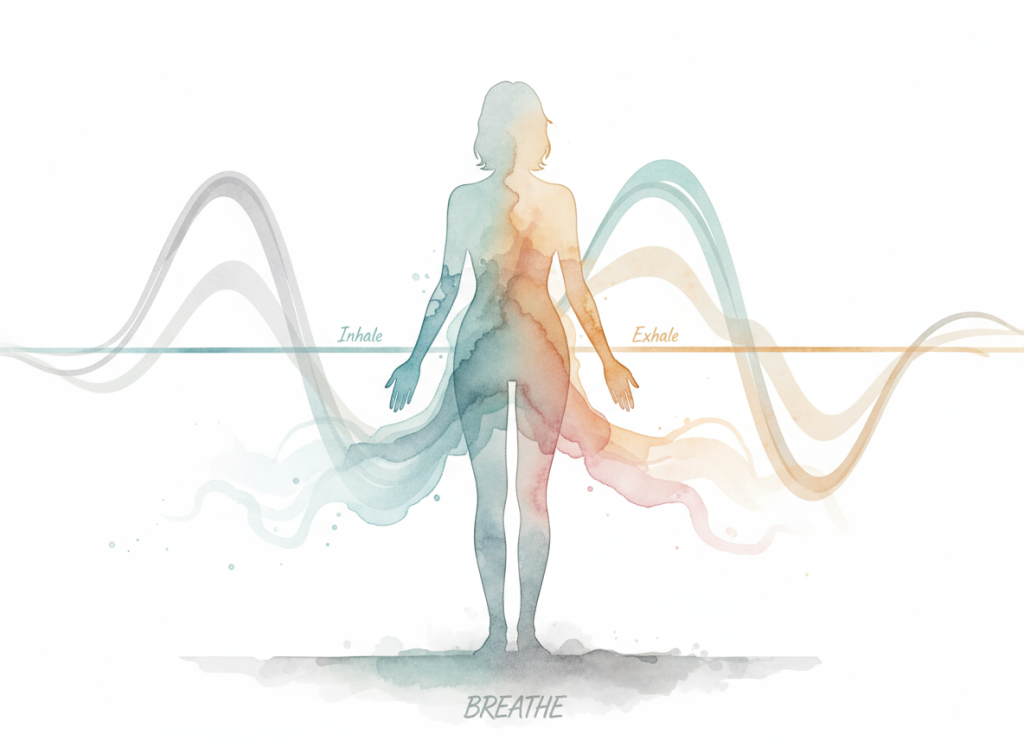
So start there. Feel your feet. Let one exhale completely. That’s still part of love’s rhythm — the inhale of protection, the exhale of connection.
Co-Regulation: How Safe Relationships Rewire Your Nervous System
Here’s something that changes everything: a regulated nervous system doesn’t just heal itself. It co-regulates others. When someone in a calm ventral vagal state interacts with a dysregulated person, their spontaneous engagement behaviors occur — a change in tone of voice, positive facial expressions. If they respond with prosodic voice and warm affect, your social engagement system gets stimulated. This is how safe relationships become vehicles for nervous system regulation. Love as regulation, not just emotion. Eye contact is particularly powerful. More than any other factor, eye contact is the main conduit for emotional connection between newborns and lovers alike.
This is why healing is relational. You can’t think your way into trusting love again. You need embodied experiences of safety with another nervous system that stays regulated in your presence. That person might be a therapist, a trusted friend, or eventually, a partner. What matters is that they can hold steady when you can’t. That they can signal safety through their own regulated state. Over time, you internalize that presence. You become both the one who loves and the one who is loved. You learn to co-regulate yourself.
Building the Container: Strategy Before Surrender
So what does choosing love actually look like in practice? It starts with reclaiming safety as something you create, not something you wait for. After trauma, the body learns that safety depends on other people’s behavior. Part of healing is realizing that safety can also come from within. Building the container means designing the conditions under which love, connection, and vulnerability can safely exist again. This happens in three layers:
1 The Physical Container — Grounding the Body
Simple but powerful practices: breathing that reaches your belly. Feeling your feet on the floor before entering an intimate space. Knowing you can leave a room if your system starts to flood. These are resources — sensations or actions that anchor you in the present. They tell your nervous system, “I can stay with myself, even in connection.”
2 The Emotional Container — Boundaries and Language
Learning to name what you feel, what you need, and what you don’t want — and practicing saying it out loud. Setting boundaries doesn’t kill love. It creates the space where love can breathe safely.
3 The Relational Container — Pacing and Consent
After trauma, the impulse to either rush into connection or avoid it completely is strong. The container is what keeps the process slow enough for your body to keep up with your heart. That might look like naming your pace to a partner: “I need time before touch.” Or “I’d like to talk about what intimacy means for me before we move forward.” These conversations are not signs of weakness. They are love’s architecture.
Once these containers are in place, surrender can finally arrive. The breath deepens. The body begins to trust its own signals. Connection starts to feel expansive instead of threatening.
The Signals Your Body Gives When It’s Ready to Love Again
How do you know when your system has regulated enough to move from self-protection back into connection? Your body will tell you, but the signals are often subtle.
The breath completes itself. In trauma, the exhale often stops halfway. When regulation begins, the breath finishes its cycle naturally. You might hear a sigh, a gentle yawn, or feel warmth spread through your chest.
Muscles soften. The shoulders lower without command. The jaw unclenches. The eyes lose their fixed stare and begin to see rather than scan.
Spontaneous curiosity returns. When you start asking, “What happens if I move toward this?” rather than “What happens if I get hurt again?” — that’s your nervous system shifting from defense to exploration.
Time feels normal again. You can sense sequence: “That was then, this is now.” Presence has returned.
The body feels more spacious. Where there was constriction, there’s room to breathe, to move, to choose.
When these signals appear, that’s not just regulation. That’s the first heartbeat of connection. And from that place, choosing love is no longer a leap of faith. It’s simply the next natural rhythm of a body that remembers safety again.
The Truth About Repetition: Why Healing Isn’t Linear
There will be days when fear returns. When old defenses rise. When your body says no, even though your heart wants to say yes. This is not failure. This is rhythm. Healing is not a straight ascent toward openness. It’s cyclical, like breath itself. There are days you expand into love and days you fold back into protection. The key is learning when to open and when to rest without shame. Over time, those moments of protection become shorter, softer, and less isolating. You no longer get stuck there. You visit and return. And each return — each small re-entry into connection — rewires your nervous system a little more toward trust.
That’s what I mean when I say love is a practice. It’s not a constant state of light. It’s a dance with shadow and sun. And the miracle is that, even when you can’t choose love easily, the intention to stay gentle with yourself is already love in motion.
From Survivor to Creator: When Love Becomes Your Authorship
There comes a moment in healing when something fundamental shifts. You stop being someone who survives love and become someone who creates it. This isn’t about erasing the past. It’s about integrating it so fully that it becomes creative material. Your body becomes an instrument of coherence. Your life becomes a rhythm that others can entrain to — a steady, compassionate beat that says: “Safety is possible. Connection is possible. Creation is possible.” You approach relationships with boundaries that aren’t walls, and vulnerability that isn’t self-erasure. You no longer confuse peace with boredom or intensity with intimacy. Your presence becomes calmer, your listening deeper. You can hold another person’s emotion without losing your own ground.
A regulated nervous system doesn’t just heal itself — it co-regulates others.
This is when trauma alchemizes into purpose. When love, once feared and lost, becomes the very energy through which you create life itself.
The One Essential Truth
If I could tell every survivor one thing, it’s this:
Love was never what broke you. It’s what will bring you home.
Trauma confused your body into believing that love and danger are the same thing. Healing is the long, patient process of teaching your body that they are not. And that doesn’t happen in one moment of courage. It happens in a thousand quiet ones: one breath, one boundary, one choice at a time. At the core, reclaiming love is not about finding someone to love you differently. It’s about remembering yourself differently. It’s realizing that your capacity for connection was never destroyed — it was only hidden beneath your body’s loyal attempts to keep you safe.
When you begin to feel your breath complete itself again, when your body softens without command, when your heart feels curiosity instead of fear — those are not small victories. Those are love returning in its truest form: as safety, as creation, as life itself. And then love stops being a risk or a reward. It becomes the rhythm by which you live. You are not here to survive love. You are here to create it — in your body, in your story, in your world. Because the moment you choose love, even trembling, even unsure, your nervous system begins to believe you. And from that moment on, every heartbeat is an act of reclamation.
Next Steps: Practical Resources for Your Healing Journey
If this article resonated with you, here are concrete next steps you can take today:
Immediate practices to begin now:
- Track your breath completion: Throughout the day, notice when your exhale stops halfway versus when it completes naturally. This simple awareness builds the foundation for regulation.
- Establish pause points: Identify one moment before entering intimate situations where you can ground yourself — feel your feet on the floor, take three complete breaths, check in with your body.
- Practice the physical container: Before making decisions about connection, spend 30 seconds feeling the support beneath you. This tells your nervous system you have a foundation.
- Name your window of tolerance: Start recognizing when you’re in hyperarousal (racing heart, scanning for danger) versus hypoarousal (numb, disconnected) versus regulated (present, curious, breathing fully).
Professional support to consider:
- Somatic Experiencing (SE) practitioners: Therapists trained in Peter Levine’s method specifically work with pendulation and nervous system regulation.
- Sensorimotor Psychotherapy: A body-centered approach that integrates talk therapy with somatic awareness.
- Trauma-informed coaches: Professionals who understand nervous system dysregulation and can guide you through the container-building process.
- EMDR therapists: Eye Movement Desensitization and Reprocessing can help reprocess traumatic memories that keep the amygdala activated.
Deepen your understanding:
- The Body Keeps the Score by Bessel van der Kolk — comprehensive research on embodied trauma healing
- Waking the Tiger by Peter Levine — foundational text on Somatic Experiencing and pendulation
- The Polyvagal Theory in Therapy by Deb Dana — practical applications of nervous system states
- In an Unspoken Voice by Peter Levine — how the body releases trauma and restores goodness
About The Empowering Story:
At The Empowering Story, I work with survivors who are ready to transform their trauma into authorship — not just of books, but of their own lives. Through trauma-informed narrative coaching, we help you reclaim your voice, rebuild your capacity for safe connection, and turn your story into a source of power rather than pain. Healing happens when we move from surviving our stories to creating them. When we stop letting trauma write our narrative and start authoring our own becoming.
Remember this:
Your capacity for love was never destroyed. It was only hidden beneath your body’s loyal attempts to keep you safe. Every breath you complete, every boundary you set, every moment you choose gentleness with yourself — these are not small acts. These are love returning in its truest form. You are not here to survive love. You are here to create it — in your body, in your relationships, in your world. And that creation begins with a single choice: to trust that your nervous system can learn safety again, one rhythm at a time.
About the Author
I’m Jean Dorff, founder of The Empowering Story. As a survivor of childhood sexual abuse myself, I spent nearly two decades in silence before finding my voice and reclaiming my story. That journey — from shame and fragmentation to authorship and wholeness — became the foundation for my life’s work. Today, I combine trauma-informed narrative coaching with somatic healing practices to help survivors transform their pain into purpose. I believe healing happens not through forgetting, but through conscious creation — when we stop letting trauma write our story and start authoring our own becoming. Through writing, speaking, and one-on-one coaching, I help survivors build the containers where love can exist safely again and where their voices can finally be heard.