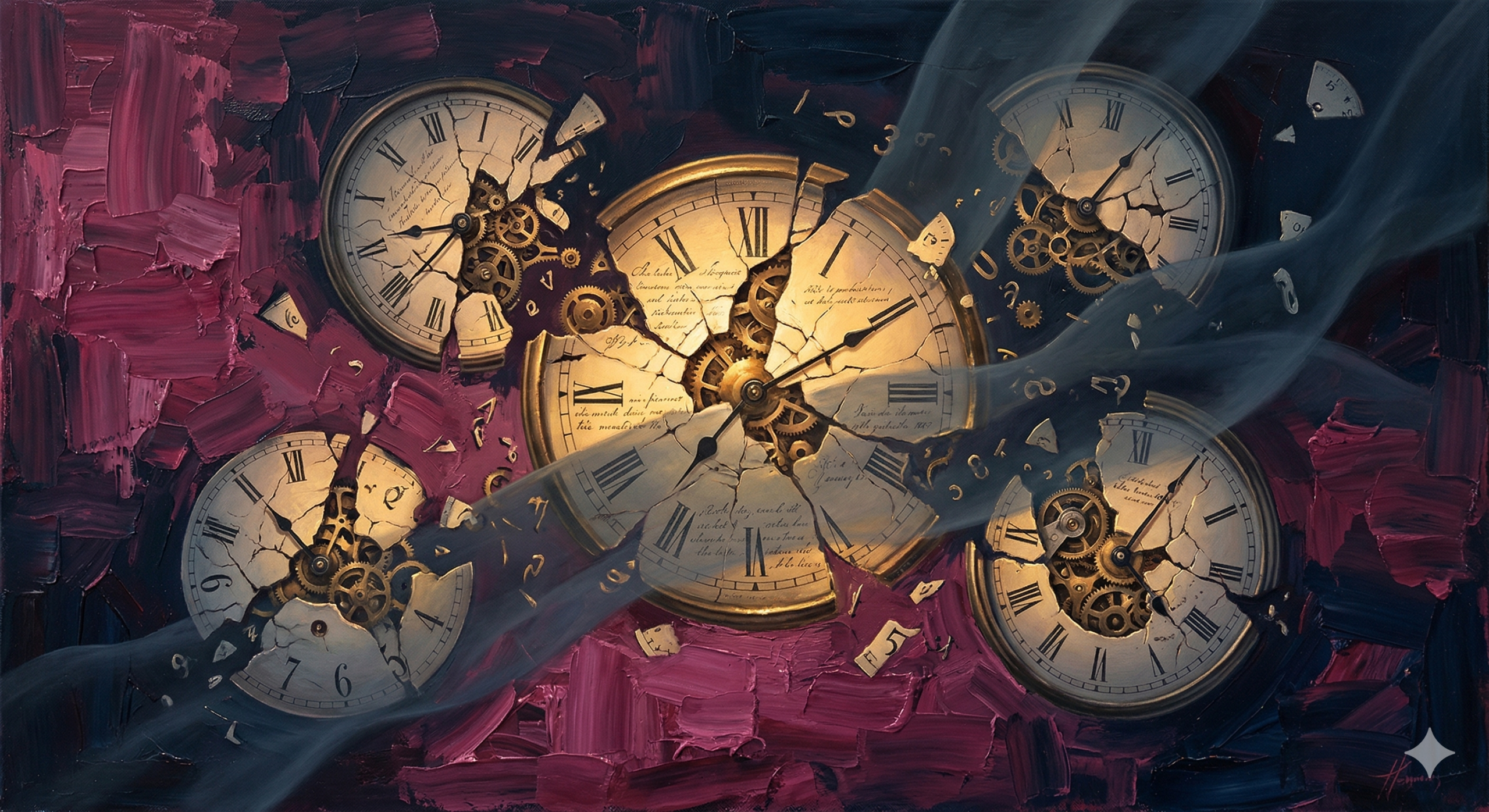

For trauma survivors, the phrase “time heals all wounds” can feel like a cruel joke. That’s because trauma doesn’t just distort memory or trigger flashbacks—it fundamentally breaks how the brain processes time itself. As a trauma recovery specialist who has worked with childhood abuse survivors for over three decades, I’ve discovered that chronic temporal dysregulation is the missing piece in trauma treatment. This article explores why current therapeutic approaches miss this critical dimension and how addressing temporal fragmentation directly can unlock recovery when traditional methods stall.
I didn’t recognize it as “temporal suspension” at the time.
I only knew something didn’t line up.
There were moments where nothing objectively threatening was happening, and yet my body reacted as if it was. What stood out was not just the intensity, but the lack of distance. It didn’t feel like I was remembering something. It felt like I was inside it again.
I could tell myself, “this is over,” but that didn’t change the response.
That was the first indication that understanding and experience were not operating in the same time frame.
After three decades of working with survivors—and living this myself—I’ve come to recognize something the trauma recovery field has documented but never fully addressed: trauma doesn’t just affect what you remember or how you feel. It fundamentally reorganizes how you experience time itself.
What you’ll learn in this article: How trauma reorganizes time perception at a neurological level, why current PTSD treatments miss chronic temporal dysregulation, the three dimensions of temporal disruption (continuity, density, and flow), specific voice markers that reveal fragmented time experience, and practical approaches to restoring temporal continuity through somatic and narrative interventions.
Why Current Trauma Treatment Misses the Temporal Dimension
Most trauma treatment focuses on two things: processing the past and grounding in the present.
Memory work. Emotional regulation. Present-moment awareness.
These approaches help. But they’re missing something foundational.
The field extensively documents how trauma distorts time during acute episodes—flashbacks, dissociation, that frozen feeling when you’re triggered. What it hasn’t developed are frameworks or treatments for the chronic temporal dysregulation that survivors live with daily.
You know this if you’ve lived it. The way past doesn’t feel past. The way future feels unreachable or vague. The way moments don’t connect into a continuous flow.
Research validates this experience. PTSD patients overestimate the duration of displayed stimuli and show more variability in time estimation compared to controls. The disturbance in temporal processing persists independently of emotional or stressful contexts.
But here’s what’s missing: the bridge between acute distortion and chronic alteration.
The field knows trauma distorts time acutely. It knows survivors report chronic temporal issues. What it hasn’t clearly articulated is how temporary becomes permanent—how episodic distortion becomes baseline reality.
Key Definition: Temporal dysregulation in trauma refers to the disruption of how the brain and nervous system organize, sequence, and experience moments across time. Unlike acute time distortion during flashbacks, chronic temporal dysregulation affects daily functioning—making it difficult to experience the past as truly past, maintain a coherent sense of present moments, or imagine a viable future.
How Temporal Fragmentation Shows Up in Trauma Survivors’ Voices
When someone who’s been through childhood trauma sits down to write or speak their story, I’m not primarily listening to the content.
I’m listening to the structure of how their experience unfolds.
Voice is not just expression. It’s a live signal of how someone is organized internally in that moment. And one of the clearest places this shows up is in their relationship to time.
The first signal: continuity or the absence of it.
In someone whose system is relatively integrated, even when they’re talking about difficult experiences, there’s a sense of movement. Their story has a before, a during, and an after. There’s a thread. You can feel that time is flowing, even if what they’re describing is painful.
But when time has been reorganized through trauma, that flow often isn’t there.
What I hear instead is jumps, loops, collapses.
A person might start in the present, suddenly shift into a past experience without marking it, and then return without realizing the transition. Or they stay inside one moment, repeating it from slightly different angles, as if they’re trying to process it in real time while speaking.
It’s not just what they’re saying. It’s that time is not moving in a linear way while they’re speaking.
The second signal: the absence of temporal markers.
You’ll hear things like: “This keeps happening.” “It’s always like this.” “I don’t know when it started.”
Or the opposite: “I remember exactly what happened, but it doesn’t feel like it was in the past.”
When the system is functioning in a regulated way, there’s an implicit ability to locate experience. This happened then. This is happening now. That might happen later.
When that ability is disrupted, everything starts to collapse into a kind of ongoing present.
The third signal: experiential density without integration.
Some survivors speak with a very high level of detail. They notice everything—tone of voice, body position, micro-expressions, exact sequences.
At first glance, it can sound like clarity.
But what I listen for is whether those details are connecting. Because often, they are not.
What you hear is high density without structure. It’s like many frames of experience are present, but they are not forming a continuous sequence.
That is one of the strongest indicators that time is not being integrated.

How Do Temporary Time Distortions Become Permanent? The Missing Bridge
Here’s what research shows about acute time distortion during trauma:
Time dilation occurs during threatening events. Overgeneralized fear in trauma survivors can trigger and fortify time dilation in neutral situations, contributing to the maintenance of PTSD symptoms through a self-perpetuating cycle.
Dissociation creates temporal fragmentation. Experiencing “temporal disintegration”—where time feels like it’s slowing down or stopping during trauma—is associated with higher levels of distress both immediately and over time.
Memory encoding becomes disrupted. During traumatic events, intense emotional activation prevents adequate integration of physiological, emotional, narrative, and episodic domains.
And here’s what research shows about chronic alterations:
Survivors develop impaired future orientation. Child sexual abuse survivors demonstrate significantly lower educational attainment and less employment opportunities, with positive future orientation mediating the relationship between abuse and these outcomes.
Identity becomes fragmented across time. Complex trauma alters sense of time by making survivors feel that past, present, and future are disconnected from one another.
Temporal self-continuity breaks down. Multiple temporal realities can exist simultaneously, especially in dissociative states.
What’s missing is the mechanistic explanation of how we get from one to the other.
I believe the answer involves two primary mechanisms: recursive encoding and hypervigilance.
Traumatic experiences are encoded with distorted temporal markers. When these memories recur as intrusive experiences, they disrupt ongoing perception and interfere with integration of new experiences. Over time, the system stops returning to a neutral temporal baseline and instead stabilizes in a modified state.
Chronic hypervigilance—a state of sustained alertness and hyperarousal in the absence of threat—predicts poorer clinical outcomes post-trauma. It maintains the system in anticipatory activation, with attention oriented toward threat, perception narrowed or intensified, and internal processing heightened.
This isn’t just psychological arousal. It’s a sustained alteration in how moments are structured.
Clinical Implication: Understanding this mechanism reveals why traditional trauma treatments that focus solely on memory reprocessing or present-moment grounding often leave survivors feeling “stuck.” Without addressing how the nervous system has reorganized time itself, cognitive insights remain disconnected from lived experience.
The Three Dimensions of Trauma-Induced Time Dysregulation
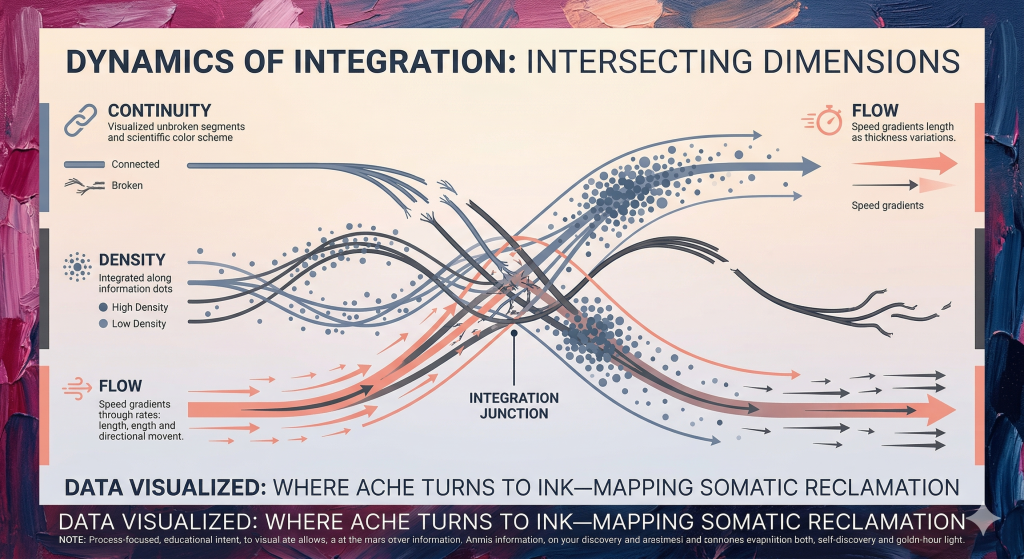
Trauma affects time through three distinct dimensions:
Continuity: The fragmentation of experience. Moments don’t flow seamlessly. Past collapses into present. The thread connecting experiences breaks.
Density: How much is experienced per moment. Some survivors process massive amounts of detail (hypervigilance creates this), while others experience numbing or dissociative gaps where time passes but nothing registers.
Flow: The subjective speed and smoothness of temporal progression. Time can feel stuck, rushed, or discontinuous. Days pass but don’t register. Or single moments feel like they last forever.
Each dimension requires specific therapeutic attention.
But current treatment protocols don’t explicitly target these. They address symptoms—flashbacks, avoidance, hyperarousal—without directly working to restore the temporal scaffolding itself.
Why Does Childhood Trauma Create Unique Temporal Disruption?
When trauma occurs during childhood, it doesn’t just distort an already-established temporal system.
It disrupts foundational development.
I remember working with a client who was describing something that had happened in her childhood. She began in a relatively grounded way, saying something like, “When I was about eight…”
But within a few sentences, that structure started to break.
Her language shifted into the present tense. She said, “He’s standing there… I can’t move… I don’t know what to do.”
At that moment, you could hear that she wasn’t remembering anymore. She was inside the experience.
Then, almost abruptly, she shifted back out. She started explaining it again, analyzing it, trying to make sense of it from an adult perspective.
Within a very short span, three different temporal positions were active: the child in the moment, the adult observing, and a kind of disoriented space in between where neither fully held.
What was especially telling was that there was no clear transition between those states.
She didn’t say, “I remember that…” or “Looking back…” The system moved between them automatically.
That’s what I mean by living in multiple temporal realities at once.
The past was not fully in the past. The present wasn’t fully stable. And the voice revealed that by constantly shifting without completing any one position.
Research supports this observation. Childhood abuse survivors develop what I call “frozen time”—remaining emotionally or behaviorally stuck at the trauma age. They experience overgeneral memory, making it difficult to recall specific events with temporal specificity. They demonstrate foreshortened future with limited capacity to imagine positive outcomes.
The developmental timing creates critical period effects. Identity formation is disrupted at a foundational level, creating discontinuity that persists across the lifespan.

Why Voice Work Addresses Temporal Structure When Talk Therapy Can’t
When someone speaks, you are not just hearing words.
You are hearing pacing, rhythm, continuity, interruption, acceleration or collapse.
You are hearing how their system is moving through time in real time.
If that movement is fragmented, no amount of insight can reorganize it directly. Because insight happens after the fact. Voice happens during the experience itself.
When I work with voice, I am working at the level where experience is still forming.
The rhythm of speaking, the ability to complete a sentence, the way one moment connects to the next—these are not just communication patterns. They are expressions of temporal structure.
When voice becomes more continuous, more grounded, more able to carry a moment to completion, something deeper is happening. The system is not just saying something differently. It is experiencing differently.
That’s why voice becomes the doorway.
You are not asking the system to change from the outside. You are meeting it inside the process of how it is already organizing experience, and gently shifting that process.
Relationally, this becomes even more powerful.
Your voice—steady, continuous, responsive—offers something the system may not have had: a consistent temporal signal that does not break.
Over time, the system begins to align with that. Not cognitively, but experientially.
It starts to feel that moments can continue, that they can complete, that experience does not have to collapse or loop.
Once that continuity is restored at the level of experience, insight can actually land.
But before that, insight often just stays in the mind, while the system continues to operate in a different temporal reality.
Practical Application: Voice-based interventions work by providing what I call “temporal scaffolding”—a steady, rhythmic relational presence that helps the nervous system learn to organize experience with continuity again. This is why writing practices, narrative therapy, and vocal expression can be transformative when implemented with temporal awareness, but ineffective when treated as purely cognitive exercises.
What Would Trauma Recovery Look Like If We Treated Time Disruption Directly?
If therapists started addressing time structure directly, the focus of sessions would shift in a noticeable way.
Less attention would go to reconstructing the story. More attention would go to how the story is being lived while it is being told.
Instead of asking, “What happened next?” the therapist might ask, “Can we stay with what is happening right now as you say this?”
Interventions would also change.
Grounding would not only mean “come back to the present,” but “can your system experience this moment as something that has a beginning, unfolds, and comes to a close?”
The goal would become restoring temporal continuity, not just reducing distress.
You would also see a different pacing in therapy. More time spent allowing experiences to complete in real time, rather than moving quickly toward insight or resolution. More attention to whether a moment has actually landed, instead of whether it has been understood.
Relationally, the therapist’s role would shift as well. Their voice, their timing, their ability to stay steady would become part of the intervention itself—because they are helping to provide a continuous temporal signal that the client’s system can begin to align with.
What would change, ultimately, is that temporal distortion would no longer be treated as a secondary symptom.
It would be recognized as a central organizing principle of the trauma response.
And once you work at that level, something important happens: you’re no longer just helping someone understand their past. You’re helping them experience their life as something that can move forward again.
Key Therapeutic Shifts:
- From “What do you remember?” to “Can you stay with what’s happening as you speak?”
- From analyzing content to tracking temporal flow
- From achieving insight to completing experiential moments
- From reducing symptoms to restoring continuity
- From cognitive understanding to somatic integration
What Does Temporal Continuity Sound Like? Signs of Recovery
When someone has restored temporal continuity, the voice changes in a very specific way.
It begins to carry time.
There is a natural sense of sequence. They begin somewhere, they stay with it, and they arrive somewhere else. And that arrival feels real—not forced, not concluded intellectually, but completed.
The pacing becomes self-regulating. They can slow down when something needs to be felt, and they can move forward when something has resolved. There is no urgency to get through the moment, and no collapse inside it.
Their voice is no longer pulled out of the present when they touch something difficult.
They can refer to the past without entering it completely.
You can hear the distinction: “This happened to me,” instead of “This is happening again.”
There is also a continuity of self. Earlier, you might hear different “versions” of the person speaking at different times—child, observer, analyst—without integration. Now, it sounds like one person moving through different experiences, rather than switching between them.
And perhaps most importantly, there is a sense that moments land.
They don’t trail off. They don’t loop endlessly. They don’t remain open in the same way.
Something completes, and the voice naturally moves on.
It doesn’t mean there is no emotion. There can still be intensity, sadness, even pain.
But the difference is that the experience is held within a flow, rather than breaking it.
If I had to describe it in one way, it would be this: The voice no longer sounds like it is searching for where it is in time. It sounds like it knows.

Why Your Trauma Recovery Feels Stalled (It’s Not What You Think)
Many people assume they are “stuck” because they haven’t understood enough.
In reality, they are stuck because their experience has not completed in time.
This creates a very specific confusion.
Someone can read, reflect, gain insight, even explain their story very clearly—and still feel like nothing is really changing.
That is often interpreted as resistance, avoidance, lack of readiness.
But in many cases, it is none of those.
It is that the system has not yet been able to experience moments in a way that allows them to land and connect.
Another important piece is that this does not always feel dramatic.
People often expect fragmentation to show up as something obvious—panic, flashbacks, breakdown.
But very often it shows up much more quietly.
It can feel like life moving, but not accumulating. Days passing, but not registering. Doing a lot, but not feeling changed by it.
That subtle version is easy to miss.
And because it is easy to miss, people often push themselves harder. More effort. More action. More trying to “move forward.”
But if the underlying issue is temporal, that strategy doesn’t work.
Because forward movement is not the problem. The problem is that experience is not connecting across time.
If your recovery feels stalled, it does not necessarily mean you are doing something wrong.
It may mean that the system is still learning something much more basic: how to experience a moment fully enough that it can end.
Because that is what creates continuity. Not intensity. Not insight. But completion.
And once that begins to happen—even in very small ways—things start to shift.
Moments begin to register. Experiences begin to accumulate. And life starts to feel like it is moving again.
You are not behind. You are not broken.
Your system may simply still be learning how to live in time again.
Key Takeaways: Understanding Temporal Disruption in Trauma Recovery
- Trauma breaks time structure, not just memory: The fundamental issue isn’t what you remember, but how your nervous system organizes experience across past, present, and future.
- Chronic temporal dysregulation is distinct from flashbacks: While flashbacks are episodic, temporal fragmentation affects daily functioning—making moments feel disconnected and future planning nearly impossible.
- Recovery stalls when temporal structure isn’t addressed: You can gain insight, understand your story, and practice grounding—yet still feel stuck if experiences aren’t completing and connecting across time.
- Voice reveals temporal organization in real time: How someone speaks—rhythm, continuity, completion—shows whether they’re living in fragmented or continuous time.
- Childhood trauma creates unique temporal signatures: When trauma occurs during developmental stages, it disrupts the formation of temporal processing itself, creating “frozen time” and multiple simultaneous temporal realities.
- Restoration requires experiential completion, not just understanding: The system learns temporal continuity by living through moments that complete with different outcomes, not by being told the past is over.
About the Author: Jean Dorff’s Approach to Trauma Recovery
Jean Dorff is a trauma recovery specialist and founder of The Empowering Story (TES), with over 30 years of experience working with survivors of childhood sexual abuse. As a professional dancer, choreographer, and dance researcher for 40+ years, Jean developed a unique methodology called Emotional Narrative Insight—integrating somatic intelligence, narrative psychology, and voice work to address temporal fragmentation in trauma survivors.
His approach is grounded in both lived experience as a survivor and decades of clinical observation. Jean’s work focuses on helping survivors restore temporal continuity through voice-based interventions, recognizing that rhythm, cadence, and expression are temporal phenomena that reveal—and can restructure—how the nervous system organizes experience across time.
Jean specializes in working with women survivors who are moving from silence to authorship, using structured narrative processes that address the underlying temporal architecture disrupted by trauma.