


By Jean Dorff, Trauma Recovery Coach & Founder of The Empowering Story
I spent years trying to explain to survivors why their pain felt so permanent when I knew the nervous system could reorganize. Every time I said something like “your brain is constructing this experience,” I watched people shut down.
They heard: Your pain isn’t real.
That’s not what I meant. But the damage was done.
The problem wasn’t the science. The science is solid. The problem was how I delivered it. I was telling people their experience was constructed without first showing them that construction doesn’t mean invalid.
Then I discovered something that changed everything.
How Color Perception Science Explains Trauma Processing
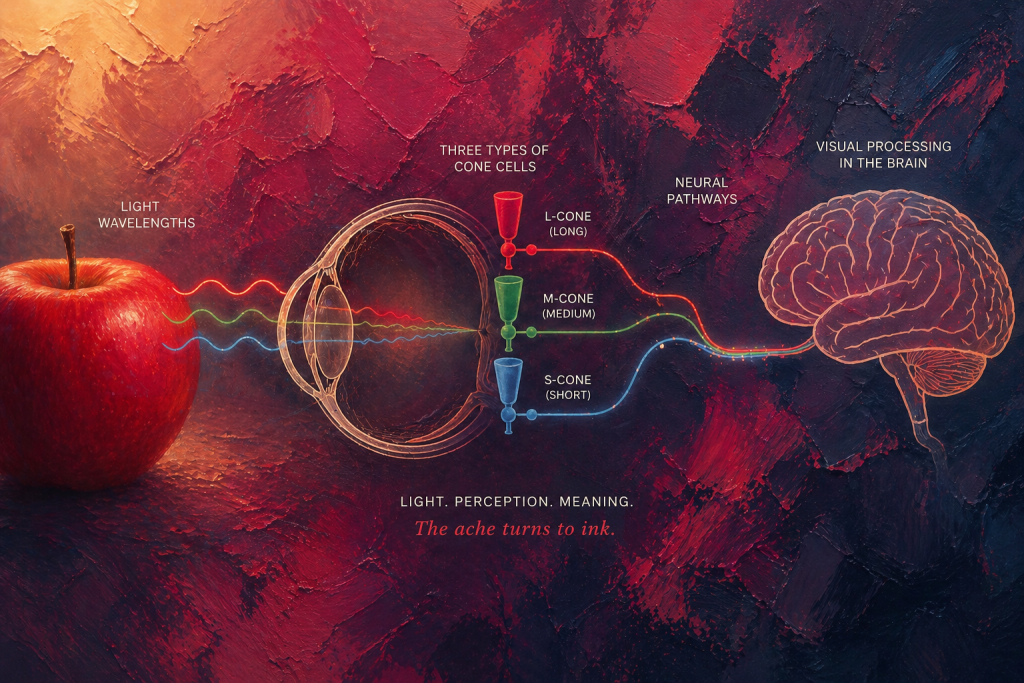
When you look at a red apple, you experience “red” as a fixed property of that apple. It feels absolute. Undeniable.
But here’s what’s actually happening.
Light hits the apple. The apple’s surface absorbs most wavelengths and reflects others—around 700 nanometers in this case. Those reflected wavelengths enter your eye and stimulate three types of cone cells. Your brain receives three numbers from those cones. From those three numbers, your brain generates the experience you call “red.”
The redness is not in the wavelength. It’s in the processing.
Two physically different light sources can produce the exact same experience of red. This phenomenon—metamerism—is why your TV can simulate millions of colors using only three wavelengths. Different inputs, same experience.
And here’s the part that matters for trauma work: that stability you feel when you see red? That’s not proof the color exists “out there.” That’s proof your system is doing effective processing.
The same principle applies to trauma.
Why Misapplied Neuroscience Destroys Therapeutic Trust
When therapists tell survivors, “your brain is creating this experience,” they’re technically correct. But they’re also accidentally communicating something devastating.
The survivor hears: You’re making this up. It’s not real. You’re the problem.
I’ve seen this rupture therapeutic relationships in a single session. The practitioner thinks they’re offering hope—”if your brain created it, your brain can change it.” The survivor feels invalidated at the deepest level.
The issue isn’t the neuroscience. Neuroplasticity research shows the nervous system can reorganize throughout life. The issue is sequencing.
If you introduce the idea that experience is constructed before you anchor the reality of what happened, you create secondary wounding.
This is where the color analogy becomes clinically powerful.
The Three-Layer Framework: Event, Encoding, and Lived Experience
In The Empowering Story framework, I make a distinction that I found was often overlooked in my early training.
There are three separate layers:
Layer 1: The Event
What actually happened. The wavelength hitting the apple. The abuse that occurred. This layer is real, objective, and cannot be changed.
Layer 2: The Encoding
How the nervous system processed and stored that event. The cone cells convert wavelengths into signals. The amygdala, hippocampus, and autonomic system organize the traumatic experience for survival. This happened under biological constraint.
Layer 3: The Lived Experience
How it shows up now. The subjective experience of “red.” The felt sense of danger, shame, or collapse that activates in the present. This is what the system continues to generate based on how it organized the original event.
When these three layers collapse into one, it creates an impossible situation: either the pain is real and unchangeable, or it’s changeable and therefore not real.
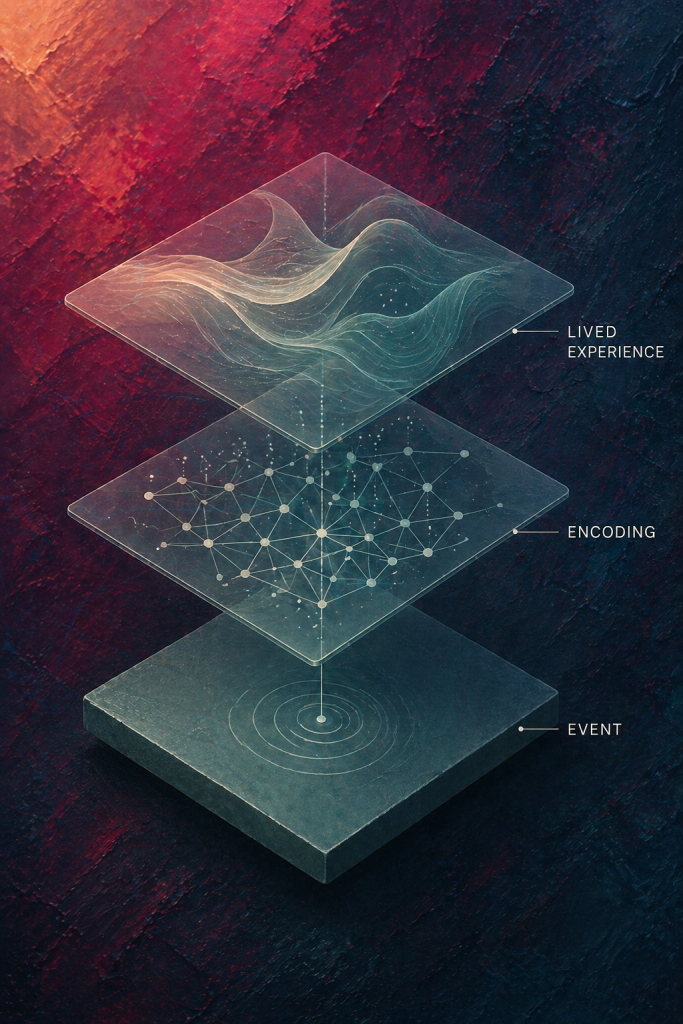
The distinction protects both truth and possibility.
The event is real. The encoding happened under constraint. The lived experience emerges from how the system holds it now. And that organization—that third layer—is not fixed.
Reading Voice as a Biometric of Nervous System Organization
I don’t just listen to what people say. I listen to how their system produces speech.
When someone intellectually understands a concept but hasn’t reorganized at the system level, I hear it immediately. Their speech fragments. Pauses land in the wrong places. The breath stays shallow. The tone doesn’t match the content.
When reorganization actually happens, everything changes.
The voice becomes continuous. Not faster, but smoother. The system stops switching states mid-sentence.
The breath redistributes. Exhalation lengthens. The person speaks on the breath instead of around it. This signals autonomic regulation, not just cognitive agreement.
The tone drops effort. It becomes more neutral, sometimes quieter, but grounded. The emotional charge reorganizes—less polarity, more integration.
Internal opposition reduces. Before the shift, you hear competing signals: “I know this makes sense, but I still feel…” That “but” is structural. It tells you multiple parts are unintegrated. When reorganization happens, the language simplifies. Fewer qualifiers. Less need to convince.
Voice is not just expression. Research shows breathing patterns, harmonic structure, and vocal quality all shift in response to autonomic state changes.
Voice is a real-time output of system organization.
I’m not listening to the story. I’m listening through it.
When Narrative Work Alone Reaches Its Limits
I worked with a woman who could explain her trauma with clarity. She understood her triggers. She had reframed her narrative multiple times. She could articulate “it’s not happening anymore.”
And yet, in specific moments, her system reacted exactly the same way. Same freeze. Same contraction. Same loss of voice.
The narrative had evolved. The response had not.
This is a gap I’ve encountered repeatedly in my work. Narrative approaches can reorganize meaning without necessarily changing what the system continues to generate.
Many approaches work from this sequence: thought → feeling → behavior
But in trauma physiology, the sequence inverts: state → perception → thought
The nervous system doesn’t wait for cognitive agreement. It produces experience through learned organization patterns shaped under constraint.
Going back to the color analogy: narrative work is like telling someone, “this shade should be called orange instead of red.” That can be useful. But it doesn’t change what the visual system is producing.
Working at the generation layer changes the underlying signal processing. It changes the three numbers the brain uses to construct experience in the first place.
When those inputs shift, the narrative reorganizes automatically. You don’t force a new story. A different story becomes the natural expression of the new state.
Understanding Temporal Collapse: When Trauma Feels Present
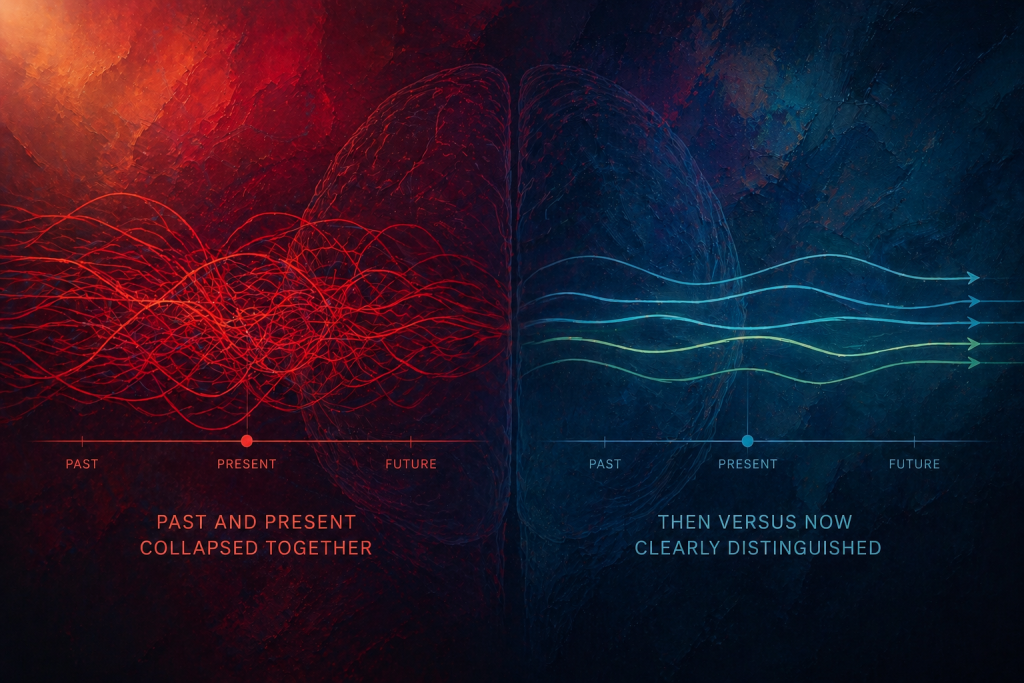
Survivors describe feeling trapped, like the abuse is still happening. This isn’t a metaphor. It’s neurological pattern completion.
Here’s the mechanism:
A present cue—tone of voice, posture, proximity, ambiguity—activates the amygdala. The amygdala doesn’t encode time. It encodes relevance and threat.
That signal recruits stored patterns from the hippocampus. But under trauma, those memories aren’t well time-stamped or context-bound. They return as current, not past.
Simultaneously, the insula and autonomic system generate the body state: heart rate, muscle tone, and breath. The prefrontal cortex loses regulatory precision under load.
The result is not “remembering.” It’s reinstantiation. The system regenerates the original state as if it’s happening now.
This is why survivors say “I know I’m safe, but it doesn’t feel that way.” Cognition is online, but it’s downstream of a system already generating present-tense experience.
When temporal binding loosens, three things change:
Hippocampal context separation improves. The system can distinguish then versus now more reliably.
Amygdala reactivity reduces or becomes more specific. Fewer false positives. Less global threat tagging.
Prefrontal modulation stabilizes under load. The person can stay oriented while activation rises.
Subjectively, this feels like: “I can feel it, but I’m not in it.”
The memory becomes accessible without being immersive.
Trauma Recovery Interventions That Create Nervous System Reorganization
You can’t instruct someone to reorganize their nervous system. You create the conditions under which the system can reorganize itself.
I work at three levels simultaneously:
Stabilizing dual awareness. I don’t pull someone out of activation, and I don’t let them fully collapse into it. I guide them to track the experience while staying oriented to the present—voice, room, posture, contact points. This reintroduces hippocampal context: this is happening, and I am here now.
Regulating through expression, not suppression. Instead of calming techniques, I work through voice, pacing, and breath inside the activation. The system learns it can express and stay regulated at the same time. This directly reduces amygdala generalization because activation no longer equals danger.
Interrupting automatic pattern completion. When the system starts to run the full old loop, I slow it down and isolate components—sensation, impulse, micro-reactions. This breaks the speed of the pattern and prevents full reinstantiation. Over time, the system stops defaulting to the same global response.
What changes neurologically is not forced. It’s emergent.
The hippocampus gets enough present-time data to recontextualize. The amygdala stops tagging activation as an immediate threat. The prefrontal system stays online because we never exceed capacity.
You’re not changing the memory. You’re changing how the system is allowed to generate it now.
Cathartic Release vs. Regulated Expression: Understanding Retraumatization
People assume expressing trauma means healing. Sometimes it does the opposite.
Cathartic release that destabilizes is an unregulated reenactment. The system exceeds capacity, loses orientation, and drops into full pattern completion. Amygdala-driven activation. Minimal prefrontal modulation. No present-time anchoring.
In that state, expression reinforces the existing circuitry. The brain encodes: This is still happening, and I have no control.
Reorganization requires a different structure: regulated expression within capacity.
Three distinctions define it:
Orientation is maintained. The person stays aware of the present while expressing. This keeps the hippocampus online, so the experience is encoded as now with activation, not back then again.
Activation is titrated, not maximized. We work at the edge where the system is activated but still organized. That window is where plasticity happens. Too little, nothing changes. Too much, it reinforces the old loop.
Expression is structured, not explosive. Instead of discharge—yelling, collapsing, flooding—the expression has continuity. Breath. Rhythm. Language or movement that stays coherent. This teaches the system a new pairing: activation and regulation can coexist.
The learning is fundamentally different.
Catharsis teaches: activation equals loss of control.
Reorganization teaches: activation doesn’t equal danger. I can stay with it.
Neurologically, that shifts prediction. The amygdala reduces global threat tagging. The system stops needing to shut down or escalate.
Dynamic Orientation: A Neurological Intervention Mechanism
Most people think orientation means knowing where you are. Name, date, location.
That’s superficial.
What I’m referring to is dynamic orientation: the system’s ability to continuously map self-in-context in real time.
Neurologically, this does three things that directly interrupt pattern completion:
It reintroduces contextual gating. Orientation supplies ongoing present-time markers—spatial, relational, sensory—that the hippocampus uses to distinguish now versus then. Without that input, the system defaults to prior templates. With it, the brain can tag activation as current-context, not past reenactment.
It stabilizes top-down modulation without suppression. Orientation is not a cognitive override. It’s a continuous updating of the situational model. That keeps prefrontal networks online during activation, so the amygdala signal is integrated rather than allowed to globalize.
It distributes attention across channels. Trauma narrows processing to a single dominant signal: threat. Orientation deliberately widens the field—body, room, voice, other—so no single signal can monopolize the system and trigger full pattern completion.
Orientation is the mechanism that updates the input conditions of experience generation.
You’re not arguing with the response. You’re changing the data the system is organizing in real time.
Pattern completion depends on closed-loop input. Orientation opens the loop—introducing enough present-time information that the system can no longer convincingly run the past as the present.
Why Voice Work Became Central to My Practice
Voice sits at a unique intersection. It’s simultaneously physiological regulation, cognitive structuring, and relational signaling—in one channel.
Direct access to autonomic regulation. Voice is tightly coupled to breath and the vagal system. When someone speaks, they’re literally shaping their exhalation, which modulates arousal in real time. Unlike movement, which can bypass breath, voice cannot. It forces regulation into the expression itself.
Real-time integration of multiple systems. To produce coherent speech, the system has to coordinate respiration, motor control, cognition, and affect. If any of these fragment, it shows immediately. That makes voice a live diagnostic of whether the system is organizing or disorganizing.
Built-in continuity requirement. Voice unfolds over time. You cannot freeze mid-sentence without it being obvious. So it naturally trains temporal continuity—exactly what trauma disrupts. Movement can be impulsive or discontinuous. Voice demands sequencing.
Intrinsically relational. Voice is designed to be heard. Even in a one-on-one session, it orients the system toward contact, not isolation. That relational context is critical for reducing threat prediction.
Voice is not just expression. It’s the most immediate externalization of how experience is being generated.
You’re not working around the system. You’re working through the exact channel that reveals and shapes its organization in real time.
The Critical Gap Between Understanding and Healing
The break came when I realized understanding did not generalize under pressure.
In sessions, everything looked integrated. Outside, under activation, the system reverted instantly.
That exposed something I needed to understand: I was working in conditions of relative safety, but the patterns were encoded for conditions of threat. I was focusing on the wrong layer.
Personally, I recognized the same mechanism. I could think differently, but in certain relational or high-stakes moments, my system would still narrow, accelerate, or fragment.
That gap—between what I knew and what I generated—became impossible to ignore.
The problem wasn’t that people didn’t understand enough. The problem was that the system generating the experience had not changed.
From there, everything reorganized around one question: Where does the experience actually get produced, and how do you work there in real time?
That question led to orientation, voice, and working inside activation rather than around it.
The Core Reframe: Healing Through System Reorganization
Healing is not the result of understanding your experience. Healing is the result of changing how your system produces it under pressure.
Most people stand in the gap thinking: If I could just understand this better, it would stop.
But the system that generates the reaction doesn’t operate on understanding. It operates on learned organization patterns shaped under constraint.
The shift is from “What do I need to realize?” to “What does my system do in real time, and can it do something different while it’s happening?”
That changes the entire target of healing.
You stop trying to fix the past or perfect the story. You start working with how the present is being generated moment by moment.
And from there, one implication follows that most people miss:
You don’t need a completely new self. You need your system to experience that it can stay organized while activated.
Because once that happens, even briefly, the system updates its prediction: This is not the same situation anymore.
That’s the beginning of real change.
Building Somatic Capacity to Hold Complexity
The pain is real. The way it’s held can change.
That statement only works if someone can hold both parts simultaneously without collapsing into either “my pain doesn’t matter” or “I’m trapped forever.”
You don’t ask them to hold the paradox conceptually. You build the capacity somatically first, and the paradox becomes tolerable afterward.
The mistake is trying to reconcile “my pain is real” and “it can change” at the level of thought. At that level, it does feel like a contradiction.
The work shifts to experience before explanation.
You anchor one side fully first. The system has to feel—not just hear—that the pain is legitimate and not being challenged. Without that, any mention of change is interpreted as threat or minimization.
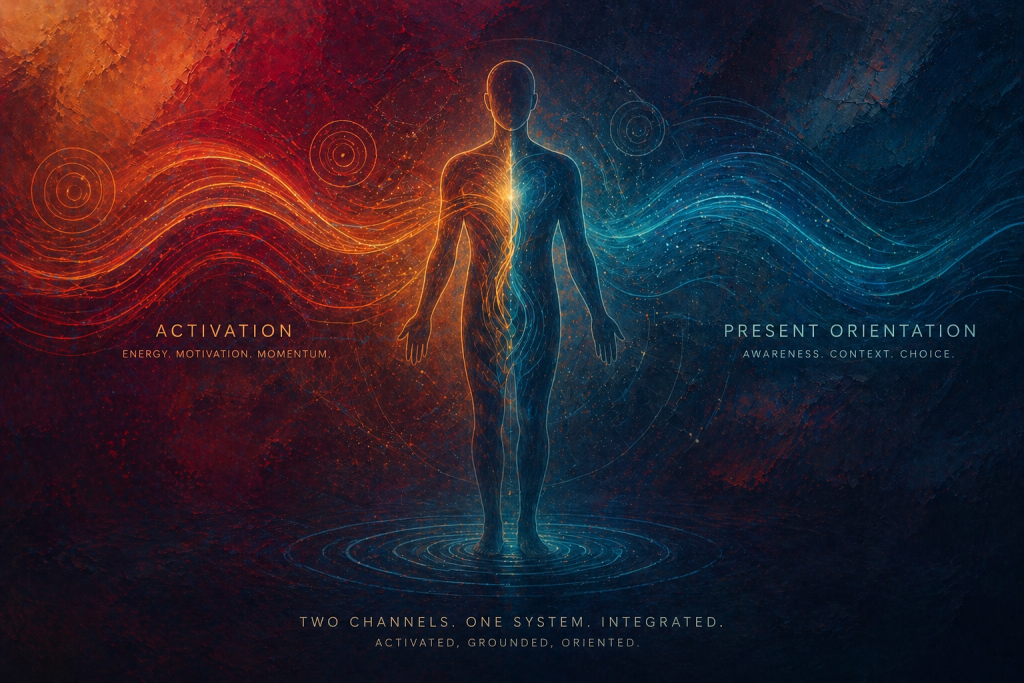
Then you introduce micro-experiences of change inside the same state. Not a big transformation. Small moments where activation is present and something else is also true: breath is steady, voice continues, awareness stays. This is critical. The system experiences coexistence, not replacement.
You stabilize dual-channel processing. Over time, the system learns it can register activation and present orientation simultaneously. That is the lived version of the paradox.
What changes is not belief. It’s tolerance for complexity.
Neurologically, you’re increasing the system’s capacity to hold multiple signals without collapsing into a single dominant pattern.
And once that capacity is there, the statement stops being a paradox and becomes obvious:
This is real. And it is not fixed.
Not because someone convinced them. Because their system has already experienced both at the same time.
Key Takeaways: Applying This Framework to Trauma Recovery
This neuroscience-based approach to trauma healing offers several critical insights I’ve found valuable for both survivors and practitioners:
- The three-layer distinction prevents invalidation while opening the possibility for change
- Voice serves as a real-time biometric revealing the organization of the nervous system
- Working at the generation layer produces deeper change than narrative reframing alone
- Orientation mechanisms interrupt temporal collapse and pattern completion
- Regulated expression within capacity reorganizes rather than retraumatizes
The color perception analogy demonstrates that constructed experiences are fully real—and also reorganizable. This framework respects both the reality of trauma and the capacity of the nervous system to change how it generates present-time experience.
About the Author
Jean Dorff is a trauma recovery coach and founder of The Empowering Story (TES), specializing in narrative transformation for sexual abuse survivors. With over 40 years of experience as a professional dancer, choreographer, and dance researcher, Jean brings unique somatic expertise to trauma work. He developed the Voice Intelligence methodology and the Six Voice States framework, integrating neuroscience, somatics, and narrative psychology into a comprehensive system for voice reclamation and healing.
If you’re a trauma survivor or practitioner interested in learning more about nervous system reorganization and voice-based trauma recovery, explore The Empowering Story framework and discover how working at the generation layer creates lasting transformation.